

Environmentally friendly accommodation and experiences
See how we care for Nuuksio’s nature at Hawkhill: peatland restoration, Lupin Battle, birdhouses built with guests and a carbon footprint reported since 2019.
Environmental work and biodiversity discover our actions and results
Hawkhill is a third-generation family business. Our cottages and villas are our childhood short bike ride away from our childhood home, and the surrounding woods and the Nuuksio National Park were our playgrounds when we were children. We want to help safeguard the area’s nature for future generations.
This connection guides our environmental work. we calculate our operational carbon footprint annually and monitor electricity and water consumption. We develop our energy use, purchasing and daily practices, while caring for local peatland restoration, meadow management and invasive species control. We also offer guests opportunities to learn about local nature and participate in its care

Our environmental objectives
- Calculate our operational carbon footprint annually and publish the key results.
- Monitor electricity and water consumption, both overall and per guest.
- Reduce emissions through changes to energy use, purchasing and daily operations.
- Work towards a calculated net-negative climate impact by 2030. We have not yet achieved this target.
- Follow the development of restored and managed habitats and participate in protecting local waters.
- Increase material reuse and consider material origins, durability and maintenance in construction.
- Help guests save energy and water, sort waste and explore nature with care.
- Publish our environmental results and next objectives annually.

Climate action and resource use
We have calculated our operational carbon footprint annually since 2019. We continue to develop the calculation and use it to guide changes to our operations.
Our target is a calculated net-negative climate impact by 2030. This target has not yet been achieved.
Energy
We purchase nuclear-generated electricity and use LED lighting, heat pumps, heat recovery and temperature controls.
In 2025, our total electricity consumption decreased by 7%, and consumption per guest decreased by 7.8%, compared with 2024.
Transport
All company-owned cars are fully electric, and we offer electric vehicle charging for guests. In 2025, we cleared and marked a 1.1-kilometre walking trail connecting Hawkhill with Kattila, the nearest bus stop, to make arrival on foot easier.
Construction, furniture and shared equipment
We use timber for villa structures and consider material origins, durability and maintenance.
We repair furniture, buy second-hand items and pass on furniture and textiles for reuse. In 2025, Metsä Lounge Tuomela received 30 second-hand chairs, and eight beds from our villas were donated to charity.
Our shared equipment collection, Lainaamo, allows guests to borrow outdoor equipment free of charge, including fishing rods, walking poles and seasonal winter equipment.

Caring for local habitats and biodiversity
A biodiversity assessment commissioned in 2023 guides our habitat management and land-use planning.
Restoring Haukansuo peatland
The Haukansuo peatland area covers approximately 6.5 hectares. Around six hectares lie on Hawkhill’s land, while approximately half a hectare is within Nuuksio National Park and the Nuuksio Natura 2000 site.
In 2023, drainage ditches were blocked on Hawkhill’s land in collaboration with Metsähallitus to help restore the peatland’s water balance. As water moves across property boundaries, restoration on our land is important for the wider peatland, including its protected section.
The work aims to retain water in the peatland, reduce peat decomposition and the associated emissions, and support wetland habitats. These changes take time. Based on the calculation assumptions used by Hiilipörssi, restoring Haukansuo could deliver an estimated annual climate benefit of approximately 12–30 tonnes of CO₂ as the peatland recovers
Meadows and wildlife habitats
We manage our meadows through grazing and invasive species removal. We also plant small flower-rich areas for pollinators. In 2025, activities with our guests included building 15 birdhouses and 10 insect hotels. We also built two deadwood fences Approximately 100 metres of boardwalk were built at Haukansuo to guide visitors along the route and help limit trampling.

Lupin Battle: community action
Every June, our meadow fills with people, scythes and rakes. The garden lupine is a harmful invasive alien species in Finland, so we mow our 6,000 m² meadow each year before it sets seed. Our neighbour’s sheep then graze it to keep regrowth down.
We didn’t want to stop at our own fence line, so we started organising Lupin Battle as a Nuuksio Lakeland event and invited neighbouring villages, local businesses and residents to join. We organise the days and show newcomers how to use a scythe, and our guests often join in too. The event has grown every year, and in three years it has become a shared effort across four villages.
Many of the sites lie along the boundary of Nuuksio National Park, and some are inside it, in a Natura 2000 area. Removing lupines there aims to keep them from spreading into protected habitats.
In 2025, participants collected about 33,500 litres of lupines, and in 2026 about 44,500 litres across Tervalampi, Huhmari, Otalampi and Veikkola. These are collected volumes, not measured changes in the meadows. Long-term control takes years of repeated work, which is why we keep coming back every summer.
Watch the video · Read more about Lupin Battle · Join us next June
Food sourcing and waste reduction
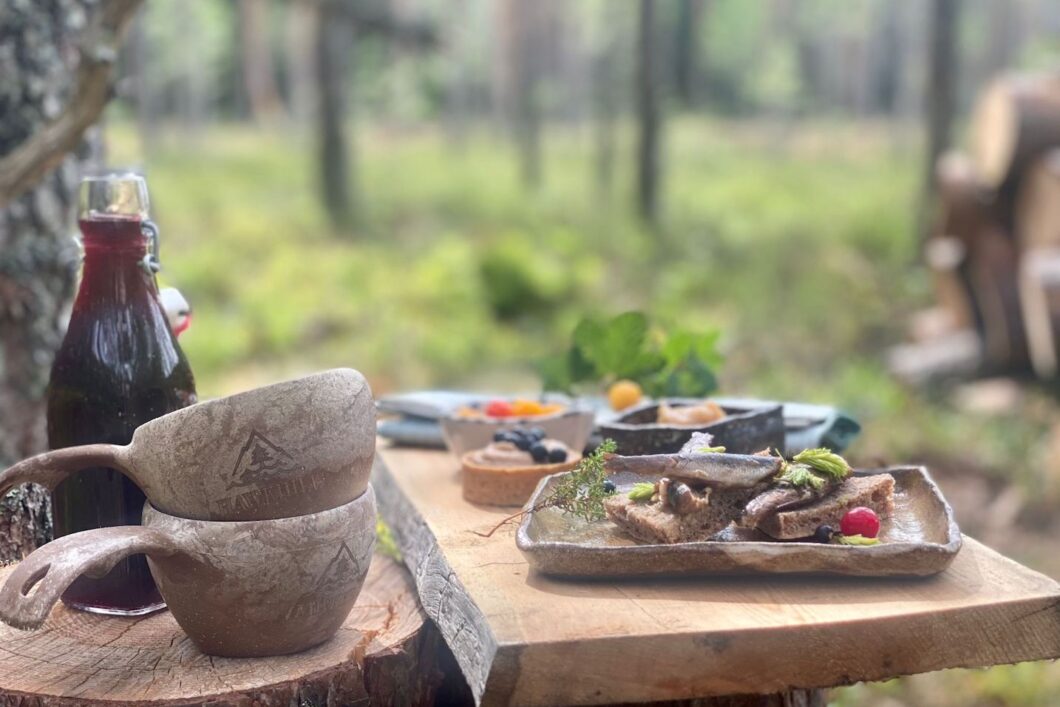
At The Wild forest restaurant, we use seasonal menus and favour vegetables, Finnish lake fish, berries, mushrooms and wild herbs.
Our food purchases in 2025
- Finnish ingredients accounted for 69% of ingredient purchases by monetary value.
- Approximately 16% of ingredient purchases by value came directly from farms, forests or local suppliers.
- Our food emissions calculation covered 96% of ingredient purchases by monetary value.
These figures describe the origin of our purchases and the coverage of our calculation. They do not, on their own, show an emissions reduction.
Our daily practices
We plan portions and ingredient quantities, use ingredients across different dishes and work to prevent food waste. Our seasonal menus help us plan purchases.
We use reusable tableware and sort restaurant waste into separate waste streams. In 2025, we replaced a kitchen refrigerator with a smaller, energy-efficient model.
At catering service 100 % waist is sorted by our chefs.
Water use and protection
We continuously monitor water consumption and have fitted flow restrictions to showers and taps. In 2025, water consumption per guest decreased by 5% compared with 2024. Our 2026 target is a further 3% reduction per overnight guest. We also use ecolabelled cleaning products and shampoos.
Peatland restoration and local waters
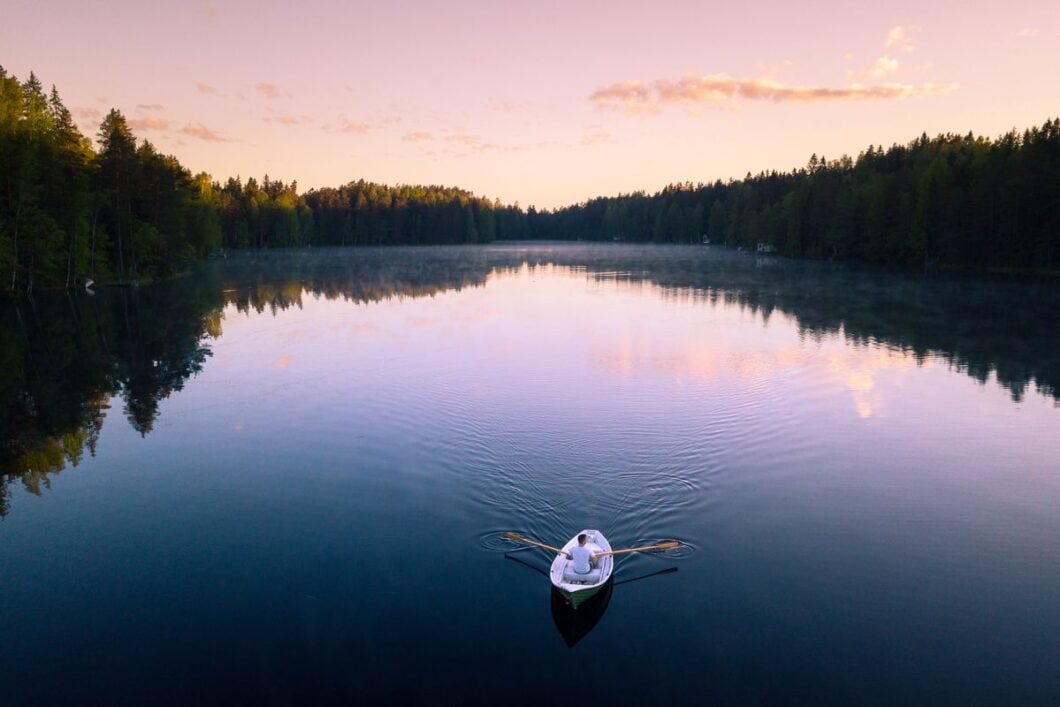
Blocking drainage ditches at Haukansuo aims to retain water in the peatland and slow drainage towards nearby lakes. We follow how conditions develop after restoration rather than assuming that water-quality improvements have already been achieved. We have also stopped fertilising our field, which aims to reduce nutrient runoff into local waters.
We participate in Lasy ry, the local association protecting the headwater lakes of the Siuntio River, and support its activities and volunteer work. In 2025, we also helped arrange water-quality testing at Lake Kaitlampi.
Hawkhill joined the Baltic Sea Challenge network in spring 2026. The network is coordinated by the cities of Helsinki and Turku and brings together organisations working to protect water bodies.
Read more about water protection in Nuuksio

Involving guests and business partners
We provide guests with practical guidance on waste sorting, saving water and energy, and following marked paths.
Guests can also learn about habitat management through guided peatland walks, lupine removal and birdhouse or insect hotel workshops. Participation is voluntary, and activities are adapted to the season and local conditions.
We provide guides and activity partners with instructions on working in the Haukkamäki nature area and caring for its habitats. We ask our partners to follow these practices and help visitors understand the local environment.